Wednesday, 3 February 2021

Sainik School GK MCQs|@9463138669|Sainik School Coaching Jalandhar|Anand Classes

CALL 9463138669, ANAND CLASSES–ALL INDIA SAINIK SCHOOL ENTRANCE EXAM COACHING CENTER IN JALANDHAR.


Revision Course : Sainik School Exam Syllabus (Topic Wise GK)Sainik School GK MCQs. Sainik School Coaching Jalandhar. RIMC RMS Coaching Jalandhar. Sainik School Coaching Jalandhar. Sainik School Exam Study Material 

We, at ANAND CLASSES, are providing the Study Material for All India Sainik School Entrance Exam  for students who want to excel in their studies and ace their final exam.

    • Emmanuel Macron is the President of which European Country?

Answer: France Sainik School GK MCQs

    • Who is the author of the book ‘Wings of Fire’? Sainik School GK MCQs

Answer: APJ Abdul Kalam and Arun Tiwari.

    • Which is the national bird of the United States of America?

Answer: Bald Eagle

    • Atacama Desert is in which continent?

Answer: South America

    • World’s longest migration done by any animal or bird in the world is?

Answer: Arctic Tern (Bird)

    • Which is the smallest bone in the human body?

Answer: Stapes

    • River Nile flows through how many countries?

Answer: 10 countries

    • When is World Heritage Day celebrated?

Answer: 18th April Sainik School GK MCQs

    • Which two rivers combine at Devprayag to form the Ganges River?

Answer: Alaknanda and Bhagirathi rivers Sainik School GK MCQs

    • Where is Mount Vesuvius located?

Answer: Italy Online Sainik School Coaching

    • Who is the Chancellor of Germany?

Answer: Angela Merkel Online Sainik School Coaching

    • Who is the author of the book ‘Ignited Minds’?

Answer: APJ Abdul Kalam Sainik School Coaching Jalandhar

    • Which country is known as the ‘Pearl of the Orient Seas’?

Answer: Philippines Sainik School Coaching Jalandhar

    • Where is the location of Kalahari Desert?

Answer: Kalahari is in African continent. It is spread over 3 countries – Botswana, Namibia and South Africa. Sainik School Coaching Jalandhar

    • Who won the Nobel Peace Prize 2020? Online Sainik School Coaching

Answer: World Food Programme Sainik School Coaching Jalandhar

    • Who won the ‘Global Teachers Prize 2020’? Online Sainik School Coaching

Answer: Ranjitsinh Disale

    • What is the capital of Switzerland?

Answer: Bern

    • When is Martyrs’ day observed in India?

Answer: 30th January

    • Which is the longest river in Europe?

Answer: Volga River RIMC RMS Coaching Jalandhar

    • Where is Mount Kilimanjaro located?

Answer: Tanzania, Africa.

http://anandclasses.co.in/sainik-school-class-6/sainik-school-class-6-gk/shape-of-earth-and-gravitation-2/RIMC RMS Coaching Jalandhar

Scientific Devices used in daily life|Anand Classes|Sainik School Coaching|@9463138669

Quantum Numbers (Principal, Azimuthal, Magnetic & Spin) - Definition, Detailed Explanation with Videos

Table of Contents

What are Quantum NumbersRecommended VideosPrincipal Quantum NumberAzimuthal Quantum NumberMagnetic Quantum NumberElectron Spin Quantum NumberSummary

Quantum numbers can be used to describe the trajectory and the movement of an electron in an atom. The quantum numbers of all the electrons in a given atom, when combined, must comply with the Schrodinger equation.

What are Quantum Numbers?

The set of numbers used to describe the position and energy of the electron in an atom are called quantum numbers. There are four quantum numbers, namely, principal, azimuthal, magnetic and spin quantum numbers.

The values of the conserved quantities of a quantum system are given by quantum numbers. Electronic quantum numbers (the quantum numbers describing electrons) can be defined as a group of numerical values which provide solutions that are acceptable by the Schrodinger wave equation for hydrogen atoms.

Quantum Numbers

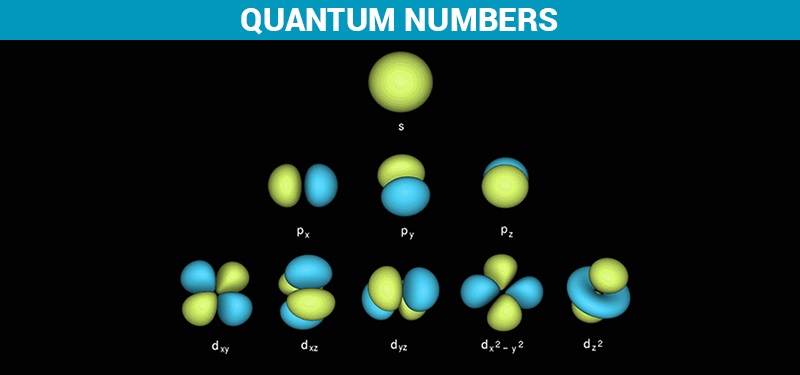
Quantum Numbers and Atomic Orbitals

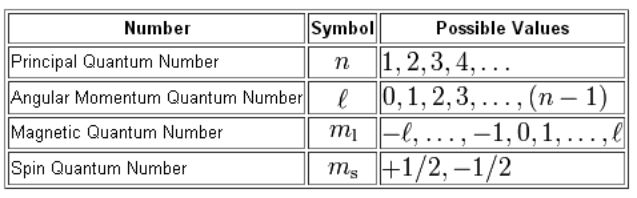
Four quantum numbers can be used to completely describe all the attributes of a given electron belonging to an atom, these are:

  • Principal quantum number, denoted by n.
  • Orbital angular momentum quantum number (or azimuthal quantum number), denoted by l.
  • Magnetic quantum number, denoted by ml.
  • The electron spin quantum number, denoted by ms.
Electronic Quantum Numbers

The Four Quantum Numbers that Describe an Electron

Recommended Videos


When the characteristics of an electron must be described in compliance with the Schrodinger wave equation, a total of four quantum numbers are used. A brief description of each of these numbers in the set of four quantum numbers that describe the unique quantum state of an electron in atomic physics can be found below.

Principal Quantum Number

  • Principal quantum numbers are denoted by the symbol ‘n’. They designate the principal electron shell of the atom. Since the most probable distance between the nucleus and the electrons is described by it, a larger value of the principal quantum number implies a greater distance between the electron and the nucleus (which, in turn, implies a greater atomic size).
  • The value of the principal quantum number can be any integer with a positive value that is equal to or greater than one. The value n=1 denotes the innermost electron shell of an atom, which corresponds to the lowest energy state (or the ground state) of an electron.
  • Thus, it can be understood that the principal quantum number, n, cannot have a negative value or be equal to zero because it is not possible for an atom to have a negative value or no value for a principal shell.
  • When a given electron is infused with energy (excited state), it can be observed that the electron jumps from one principle shell to a higher shell, causing an increase in the value of n. Similarly, when electrons lose energy, they jump back into lower shells and the value of n also decreases.
  • The increase in the value of n for an electron is called absorption, emphasizing the photons or energy being absorbed by the electron. Similarly, the decrease in the value of n for an electron is called emission, where the electrons emit their energy.

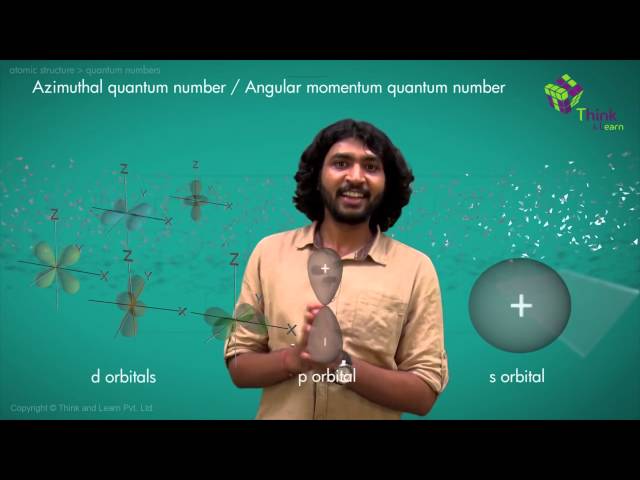
Azimuthal Quantum Number (Orbital Angular Momentum Quantum Number)

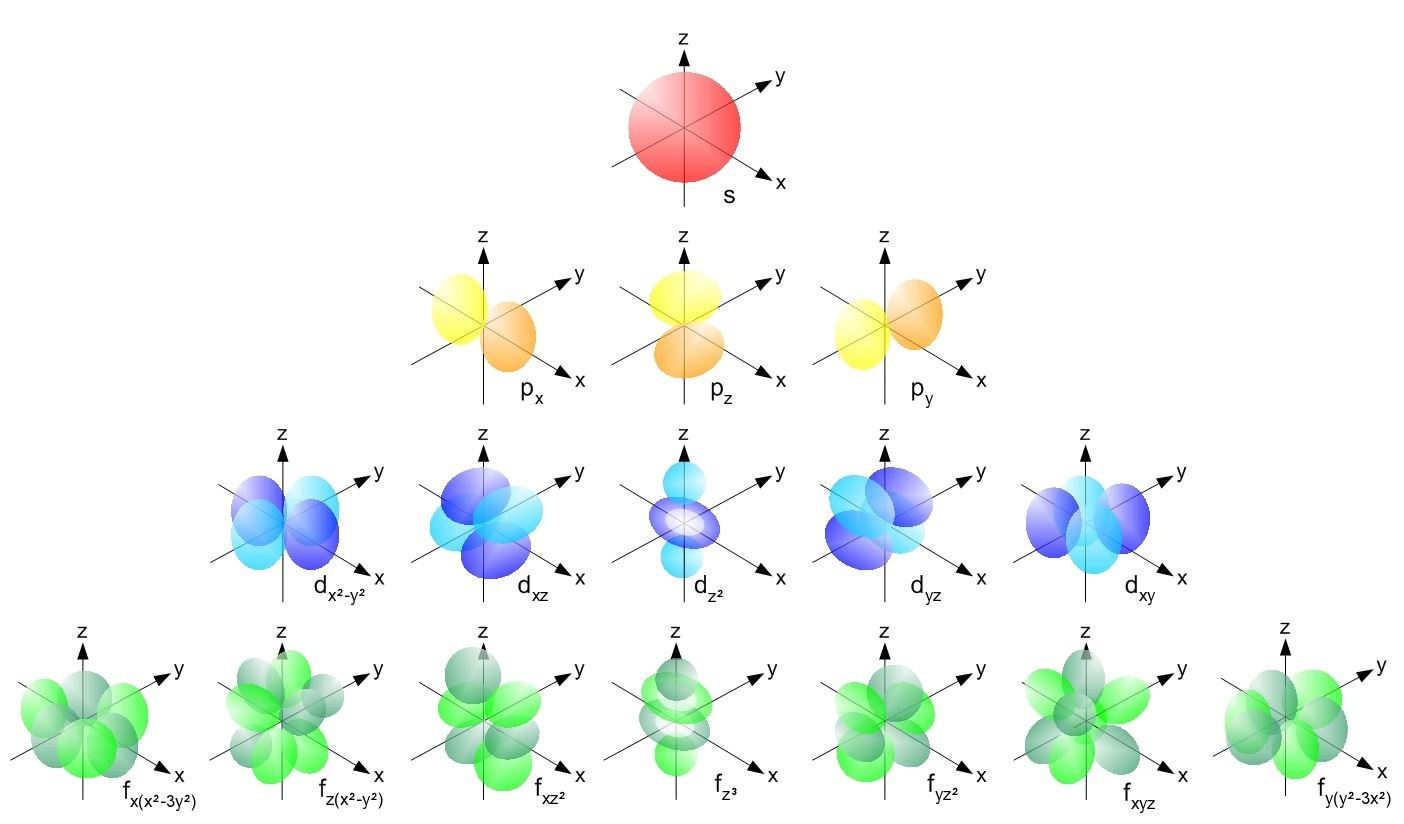
  • The azimuthal (or orbital angular momentum) quantum number describes the shape of a given orbital. It is denoted by the symbol ‘l’ and its value is equal to the total number of angular nodes in the orbital.
  • A value of the azimuthal quantum number can indicate either an s, p, d, or f subshell which vary in shapes. This value depends on (and is capped by) the value of the principal quantum number, i.e. the value of the azimuthal quantum number ranges between 0 and (n-1).
  • For example, if n =3, the azimuthal quantum number can take on the following values – 0,1, and 2. When l=0, the resulting subshell is an ‘s’ subshell. Similarly, when l=1 and l=2, the resulting subshells are ‘p’ and ‘d’ subshells (respectively). Therefore, when n=3, the three possible subshells are 3s, 3p, and 3d.
  • In another example where the value of n is 5, the possible values of l are 0, 1, 2, 3, and 4. If l = 3, then there are a total of three angular nodes in the atom.
    Combinations of the Principal and Azimuthal Quantum Numbers

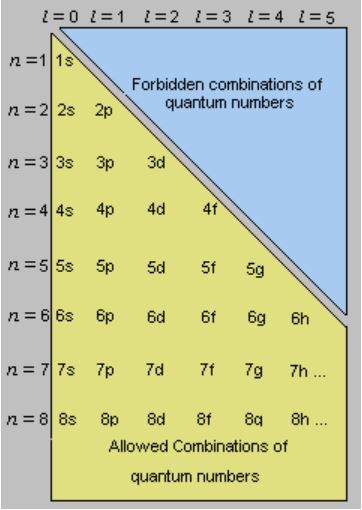
    Combinations of the Principal and Azimuthal Quantum Numbers

The allowed subshells under different combinations of ‘n’ and ‘l’ are listed above. It can be understood that the ‘2d’ orbital cannot exist since the value of ‘l’ is always less than that of ‘n’.

Magnetic Quantum Number

The total number of orbitals in a subshell and the orientation of these orbitals are determined by the magnetic quantum number. It is denoted by the symbol ‘ml’. This number yields the projection of the angular momentum corresponding to the orbital along a given axis.

Orbitals as per Quantum Numbers

Shapes of Orbitals (as per the corresponding Quantum Numbers)

The value of the magnetic quantum number is dependant on the value of the azimuthal (or orbital angular momentum) quantum number. For a given value of l, the value of ml ranges between the interval -l to +l. Therefore, it indirectly depends on the value of n.

For example, if n = 4 and l = 3 in an atom, the possible values of the magnetic quantum number are -3, -2, -1, 0, +1, +2, and +3.

Azimuthal Quantum Number ValueCorresponding Number of Orbitals (2l + 1)Possible Values of ml
0 (‘s’ subshell)2*0 + 1 = 10
1 (‘p’ subshell)2*1 + 1 = 3-1, 0, and 1
2 (‘d’ subshell)2*2 + 1 = 5-2, -1, 0, 1, and 2
3 (‘f’ subshell)2*3 + 1 = 7-3, -2, -1, 0, 1, 2, and 3

The total number of orbitals in a given subshell is a function of the ‘l’ value of that orbital. It is given by the formula (2l + 1). For example, the ‘3d’ subshell (n=3, l=2) contains 5 orbitals (2*2 + 1). Each orbital can accommodate 2 electrons. Therefore, the 3d subshell can hold a total of 10 electrons.

Electron Spin Quantum Number

  • The electron spin quantum number is independent of the values of n, l, and ml. The value of this number gives insight into the direction in which the electron is spinning, and is denoted by the symbol ms.
  • The value of ms offers insight into the direction in which the electron is spinning. The possible values of the electron spin quantum number are +½ and -½.
  • The positive value of ms implies an upward spin on the electron which is also called ‘spin up’ and is denoted by the symbol ↑. If ms has a negative value, the electron in question is said to have a downward spin, or a ‘spin down’, which is given by the symbol ↓.
  • The value of the electron spin quantum number determines whether the atom in question has the ability to produce a magnetic field. The value of ms can be generalized to ±½.

Summary

In order to simplify the details of the four different quantum numbers that are related to atomic physics, a tabular column detailing their names, symbols, meanings, and possible values is provided below.

Name and SymbolMeaning and Possible Values
Principal quantum number, nElectron shell, n ≥ 1
Azimuthal quantum number, lSubshells (s=0, p=1, etc.) , (n-1) ≥ l ≥ 0
Magnetic quantum number, mlTotal number and orientation of orbitals, l≥ml≥-l
Electron spin quantum number, msThe direction of electron spin, ms = ±½

It is important to note that it is impossible for two electrons of the same atom to have exactly the same quantum state or exactly the same values of the set of quantum numbers, as per Hund’s rules.

Solved Examples

What are the Possible Subshells when n = 4? How Many Orbitals are Contained by Each of these Subshells?

When n = 4, the possible l values are 0, 1, 2, and 3. This implies that the 4 possible subshells are the 4s, 4p, 4d, and 4f subshells.

  • The 4s subshell contains 1 orbital and can hold up to 2 electrons.
  • The 4p subshell contains 3 orbitals and can hold up to 6 electrons.
  • The 4d subshell contains 5 orbitals and can hold up to 10 electrons.
  • The 4f subshell has 7 orbitals and can hold up to 14 electrons.

Thus, a total of 4 subshells are possible for n = 4.

What are the Possible ml values for l = 4?

Since the value of the magnetic quantum number ranges from -l to l, the possible values of ml when l = 4 are: -4, -3, -2, -1, 0, 1, 2, 3, and 4.

Frequently Asked Questions – FAQs

Who proposed the principal quantum number?

The notion of energy levels and notation has been taken from the atom ‘s earlier Bohr model. Schrodinger ‘s equation evolved the concept from a two-dimensional flat Bohr atom to a three-dimensional model for wave motion. Where n = 1 , 2 , 3 is called the main quantity, and h is the constant of Planck.

Why are there only 8 electrons in the outer shell?

The stability of an atom ‘s eight-electrons derives from the stability of the noble gases or the elder term of inert gases, also known as unreactive or noble gases. This law, however, is justified in the periodic table for second row elements whose outermost-shell capacity is 8 electrons.

How do you find the principal quantum number?

The principal quantum number n value is the level of the central electronic shell (central level). All orbitals with the same n value are at the same key stage. All orbitals on the second main stage , for example, have a principal quantity of n=2.

What are the principal energy levels?

In chemistry, an electron’s primary energy level refers to the shell or orbital in which the electron resides relative to the nucleus of the atom. The principal quantum number n denotes this level. Within a time of the periodic table the first element introduces a new key energy level.

Which energy level has the least energy?

There is a single 1s orbital that can accommodate 2 electrons at the lowest energy level, the one nearest to the atomic core. There are four orbitals at the next energy level; a 2s, 2p1, 2p2 and a 2p3. Each of these orbitals can carry 2 electrons, so we can find a total of 8 electrons at this energy level.

What is Quantum Energy?

Quantum, in mechanics, of energy, charge, angular momentum, or other physical property, discrete natural unit, or bundle. Photons, a concept often applied to quanta with other sources of electromagnetic radiation such as X rays and gamma rays, are certain particle-like packets of light.

What is magnetic Polarisation?

The vector field that represents the density of permanent or induced magnetic dipole moments in a magnetic medium is magnetization or magnetic polarisation in classical electromagnetism. A pseudovector M is represented.

What is the spin of an electron?

A quantum property of electrons is electron spin. It is an angular momentum shape. Instructors also equate electron spin to the planet rotating on its own axis every 24 hours as a teaching technique. If the electron spins on its axis clockwise, it is known as spin-up; spin-down is counterclockwise.

To learn more about quantum numbers and their uses in writing electron configurations, download the ANAND CLASSES mobile application on your smartphone.

Monday, 1 February 2021

Sainik School GK MCQs|@9463138669|Sainik School Coaching|Anand Classes

CALL 9463138669, ANAND CLASSES–ALL INDIA SAINIK SCHOOL ENTRANCE EXAM COACHING CENTER IN JALANDHAR.

Revision Course : Sainik School Exam Syllabus (Topic Wise GK)Sainik School GK MCQs. Sainik School Coaching Jalandhar. RIMC RMS Coaching Jalandhar. Sainik School Coaching Jalandhar. Sainik School Exam Study Material 

We, at ANAND CLASSES, are providing the Study Material for All India Sainik School Entrance Exam  for students who want to excel in their studies and ace their final exam.

SET-1


Question No (1) What is the full form of CBSE?
Answer: Central Board of Secondary Education.

Question No (2) Prime Minister of India ‘Narendra Modi’ born on which date?
Answer: 17 September 1950.

Question No (3) Which country produce higher amount of Black pepper in the world?
Answer: Vietnam.

Question No (4) The Red Fort is located at where in India?
Answer: Delhi.

Question No (5) Udaipur is famous city in which state of India?
Answer: Rajasthan.

Question No (6) Indira Gandhi born in which year?
Answer: 1917.

Question No (7) Where is the ‘Mount Abu’ in India?
Answer: Rajshthan State.

Question No (8) Taj Mahal is also known as which name?
Answer: Crown Palace.

Question No (9) Where is ‘Pangong Lake’ (also known as Pangong Tso) in India?
Answer: Ladakh.

Question No (10) Where is Jama Masjid in India?
Answer: Delhi.


Question No (11) Dr Bhim Rao Ambedkar is know as ___ of Indian Constitution?
Answer: Father. Online Sainik School Coaching

Question No (12) Hawa Mahal is located in which state of India?
Answer: Rajasthan. Online Sainik School Coaching

Question No (13) What is the full form of IRCTC?
Answer: Indian Railways Catering and Tourism Corporation. Online Sainik School Coaching

Question No (14) Temple of Badrinath is located in which state of India?
Answer: Uttarakhand (Chamoli district).

Question No (15) Jantar Mantar (New Delhi) was founded by whom?
Answer: Maharaja Jai Singh II. Online Sainik School Coaching

Question No (16) Mouse is ___ device in computer system?
Answer: Input.

Question No (17) World War II ended in which year?
Answer: 1945.

Question No (18) Rose is the flowering plant comes under which family?
Answer: Rosaceae family.

Question No (19) How many colors are there in a Rambo?
Answer: Seven.

Question No (20) Nokia is which type of company?
Answer: Telecommunications company.


Question No (21) What is the reason for high heat of the sun?
Answer: Nuclear fusion of hydrogen.

Question No (22) Netaji Subhash Chandra Bose International Airport is in which city?
Answer: Kolkata.

Question No (23) Why does the snow float on the water?
Answer: Due to less density than water. RIMC RMS Coaching Jalandhar

Question No (24) Ozan layer protects the earth from whom?
Answer: Space and other radiation. RIMC RMS Coaching Jalandhar

Question No (25) Which game is related to the Ranji Trophy?
Answer: Cricket.

Sainik School Coaching Jalandhar|Shape of Earth & Gravitation|Anand Classes|@9463138669|

Scientific Devices Used in Daily Life|Sainik School Exam|@9463138669|Anand Classes


RIMC RMS Coaching Jalandhar

Quantum Numbers (Principal, Azimuthal, Magnetic & Spin) - Definition, Detailed Explanation with Videos

Table of Contents

What are Quantum NumbersRecommended VideosPrincipal Quantum NumberAzimuthal Quantum NumberMagnetic Quantum NumberElectron Spin Quantum NumberSummary

Quantum numbers can be used to describe the trajectory and the movement of an electron in an atom. The quantum numbers of all the electrons in a given atom, when combined, must comply with the Schrodinger equation.

What are Quantum Numbers?

The set of numbers used to describe the position and energy of the electron in an atom are called quantum numbers. There are four quantum numbers, namely, principal, azimuthal, magnetic and spin quantum numbers.

The values of the conserved quantities of a quantum system are given by quantum numbers. Electronic quantum numbers (the quantum numbers describing electrons) can be defined as a group of numerical values which provide solutions that are acceptable by the Schrodinger wave equation for hydrogen atoms.

Quantum Numbers

Quantum Numbers and Atomic Orbitals

Four quantum numbers can be used to completely describe all the attributes of a given electron belonging to an atom, these are:

  • Principal quantum number, denoted by n.
  • Orbital angular momentum quantum number (or azimuthal quantum number), denoted by l.
  • Magnetic quantum number, denoted by ml.
  • The electron spin quantum number, denoted by ms.
Electronic Quantum Numbers

The Four Quantum Numbers that Describe an Electron

Recommended Videos


When the characteristics of an electron must be described in compliance with the Schrodinger wave equation, a total of four quantum numbers are used. A brief description of each of these numbers in the set of four quantum numbers that describe the unique quantum state of an electron in atomic physics can be found below.

Principal Quantum Number

  • Principal quantum numbers are denoted by the symbol ‘n’. They designate the principal electron shell of the atom. Since the most probable distance between the nucleus and the electrons is described by it, a larger value of the principal quantum number implies a greater distance between the electron and the nucleus (which, in turn, implies a greater atomic size).
  • The value of the principal quantum number can be any integer with a positive value that is equal to or greater than one. The value n=1 denotes the innermost electron shell of an atom, which corresponds to the lowest energy state (or the ground state) of an electron.
  • Thus, it can be understood that the principal quantum number, n, cannot have a negative value or be equal to zero because it is not possible for an atom to have a negative value or no value for a principal shell.
  • When a given electron is infused with energy (excited state), it can be observed that the electron jumps from one principle shell to a higher shell, causing an increase in the value of n. Similarly, when electrons lose energy, they jump back into lower shells and the value of n also decreases.
  • The increase in the value of n for an electron is called absorption, emphasizing the photons or energy being absorbed by the electron. Similarly, the decrease in the value of n for an electron is called emission, where the electrons emit their energy.

Azimuthal Quantum Number (Orbital Angular Momentum Quantum Number)

  • The azimuthal (or orbital angular momentum) quantum number describes the shape of a given orbital. It is denoted by the symbol ‘l’ and its value is equal to the total number of angular nodes in the orbital.
  • A value of the azimuthal quantum number can indicate either an s, p, d, or f subshell which vary in shapes. This value depends on (and is capped by) the value of the principal quantum number, i.e. the value of the azimuthal quantum number ranges between 0 and (n-1).
  • For example, if n =3, the azimuthal quantum number can take on the following values – 0,1, and 2. When l=0, the resulting subshell is an ‘s’ subshell. Similarly, when l=1 and l=2, the resulting subshells are ‘p’ and ‘d’ subshells (respectively). Therefore, when n=3, the three possible subshells are 3s, 3p, and 3d.
  • In another example where the value of n is 5, the possible values of l are 0, 1, 2, 3, and 4. If l = 3, then there are a total of three angular nodes in the atom.
    Combinations of the Principal and Azimuthal Quantum Numbers

    Combinations of the Principal and Azimuthal Quantum Numbers

The allowed subshells under different combinations of ‘n’ and ‘l’ are listed above. It can be understood that the ‘2d’ orbital cannot exist since the value of ‘l’ is always less than that of ‘n’.

Magnetic Quantum Number

The total number of orbitals in a subshell and the orientation of these orbitals are determined by the magnetic quantum number. It is denoted by the symbol ‘ml’. This number yields the projection of the angular momentum corresponding to the orbital along a given axis.

Orbitals as per Quantum Numbers

Shapes of Orbitals (as per the corresponding Quantum Numbers)

The value of the magnetic quantum number is dependant on the value of the azimuthal (or orbital angular momentum) quantum number. For a given value of l, the value of ml ranges between the interval -l to +l. Therefore, it indirectly depends on the value of n.

For example, if n = 4 and l = 3 in an atom, the possible values of the magnetic quantum number are -3, -2, -1, 0, +1, +2, and +3.

Azimuthal Quantum Number ValueCorresponding Number of Orbitals (2l + 1)Possible Values of ml
0 (‘s’ subshell)2*0 + 1 = 10
1 (‘p’ subshell)2*1 + 1 = 3-1, 0, and 1
2 (‘d’ subshell)2*2 + 1 = 5-2, -1, 0, 1, and 2
3 (‘f’ subshell)2*3 + 1 = 7-3, -2, -1, 0, 1, 2, and 3

The total number of orbitals in a given subshell is a function of the ‘l’ value of that orbital. It is given by the formula (2l + 1). For example, the ‘3d’ subshell (n=3, l=2) contains 5 orbitals (2*2 + 1). Each orbital can accommodate 2 electrons. Therefore, the 3d subshell can hold a total of 10 electrons.

Electron Spin Quantum Number

  • The electron spin quantum number is independent of the values of n, l, and ml. The value of this number gives insight into the direction in which the electron is spinning, and is denoted by the symbol ms.
  • The value of ms offers insight into the direction in which the electron is spinning. The possible values of the electron spin quantum number are +½ and -½.
  • The positive value of ms implies an upward spin on the electron which is also called ‘spin up’ and is denoted by the symbol ↑. If ms has a negative value, the electron in question is said to have a downward spin, or a ‘spin down’, which is given by the symbol ↓.
  • The value of the electron spin quantum number determines whether the atom in question has the ability to produce a magnetic field. The value of ms can be generalized to ±½.

Summary

In order to simplify the details of the four different quantum numbers that are related to atomic physics, a tabular column detailing their names, symbols, meanings, and possible values is provided below.

Name and SymbolMeaning and Possible Values
Principal quantum number, nElectron shell, n ≥ 1
Azimuthal quantum number, lSubshells (s=0, p=1, etc.) , (n-1) ≥ l ≥ 0
Magnetic quantum number, mlTotal number and orientation of orbitals, l≥ml≥-l
Electron spin quantum number, msThe direction of electron spin, ms = ±½

It is important to note that it is impossible for two electrons of the same atom to have exactly the same quantum state or exactly the same values of the set of quantum numbers, as per Hund’s rules.

Solved Examples

What are the Possible Subshells when n = 4? How Many Orbitals are Contained by Each of these Subshells?

When n = 4, the possible l values are 0, 1, 2, and 3. This implies that the 4 possible subshells are the 4s, 4p, 4d, and 4f subshells.

  • The 4s subshell contains 1 orbital and can hold up to 2 electrons.
  • The 4p subshell contains 3 orbitals and can hold up to 6 electrons.
  • The 4d subshell contains 5 orbitals and can hold up to 10 electrons.
  • The 4f subshell has 7 orbitals and can hold up to 14 electrons.

Thus, a total of 4 subshells are possible for n = 4.

What are the Possible ml values for l = 4?

Since the value of the magnetic quantum number ranges from -l to l, the possible values of ml when l = 4 are: -4, -3, -2, -1, 0, 1, 2, 3, and 4.

Frequently Asked Questions – FAQs

Who proposed the principal quantum number?

The notion of energy levels and notation has been taken from the atom ‘s earlier Bohr model. Schrodinger ‘s equation evolved the concept from a two-dimensional flat Bohr atom to a three-dimensional model for wave motion. Where n = 1 , 2 , 3 is called the main quantity, and h is the constant of Planck.

Why are there only 8 electrons in the outer shell?

The stability of an atom ‘s eight-electrons derives from the stability of the noble gases or the elder term of inert gases, also known as unreactive or noble gases. This law, however, is justified in the periodic table for second row elements whose outermost-shell capacity is 8 electrons.

How do you find the principal quantum number?

The principal quantum number n value is the level of the central electronic shell (central level). All orbitals with the same n value are at the same key stage. All orbitals on the second main stage , for example, have a principal quantity of n=2.

What are the principal energy levels?

In chemistry, an electron’s primary energy level refers to the shell or orbital in which the electron resides relative to the nucleus of the atom. The principal quantum number n denotes this level. Within a time of the periodic table the first element introduces a new key energy level.

Which energy level has the least energy?

There is a single 1s orbital that can accommodate 2 electrons at the lowest energy level, the one nearest to the atomic core. There are four orbitals at the next energy level; a 2s, 2p1, 2p2 and a 2p3. Each of these orbitals can carry 2 electrons, so we can find a total of 8 electrons at this energy level.

What is Quantum Energy?

Quantum, in mechanics, of energy, charge, angular momentum, or other physical property, discrete natural unit, or bundle. Photons, a concept often applied to quanta with other sources of electromagnetic radiation such as X rays and gamma rays, are certain particle-like packets of light.

What is magnetic Polarisation?

The vector field that represents the density of permanent or induced magnetic dipole moments in a magnetic medium is magnetization or magnetic polarisation in classical electromagnetism. A pseudovector M is represented.

What is the spin of an electron?

A quantum property of electrons is electron spin. It is an angular momentum shape. Instructors also equate electron spin to the planet rotating on its own axis every 24 hours as a teaching technique. If the electron spins on its axis clockwise, it is known as spin-up; spin-down is counterclockwise.

To learn more about quantum numbers and their uses in writing electron configurations, download the ANAND CLASSES mobile application on your smartphone.

Sunday, 31 January 2021

Non-Renewable Energy Sources|Sainik School Coaching|Anand Classes|@9463138669

CALL 9463138669, ANAND CLASSES–ALL INDIA SAINIK SCHOOL ENTRANCE EXAM COACHING CENTER IN JALANDHAR.

Revision Course : Sainik School Exam Syllabus (Topic Wise GK)Shape of Earth and Gravitation MCQs. Sainik School Coaching Jalandhar

Topic : Non-Renewable Energy Sources (Fossil
Fuels) RIMC RMS Coaching Jalandhar

Shape of Earth and Gravitation. Sainik School Coaching Jalandhar 

We, at ANAND CLASSES, are providing the Study Material for All India Sainik School Entrance Exam  for students who want to excel in their studies and ace their final exam.

Sainik School Coaching Jalandhar. Sainik School Exam Study Material

Q1. What is a good source of energy?

Solution:

A good source of energy has the following properties:

  • Be economical
  • Easy storage and transportation
  • Easy availability
  • Work done per unit volume or mass should be large.

Q2. What is a good fuel?

Solution:

A fuel is said to be good when it is easily available and when it produces a large amount of heat energy when burnt.

Q3. If you could use any source of energy for heating your food, which one would you use and why?

Solution:

For heating and cooking, natural gas can be used for the below given reasons:

  • It is easy to use
  • It is easily available
  • Easy transportation
  • It does not produce huge amount of smoke when burnt
  • It is highly inflammable.

Q1. What are the disadvantages of fossil fuels?

Solution:

Following are the disadvantages of fossil fuels:

  • Fossil fuels like coal and petroleum results in air pollution as there is release of huge amount of pollutants.
  • Gases such as carbon dioxide is released when a fossil fuel is burnt, which causes global warming.
  • Soil fertility and potable water is affected by the oxides of carbon, nitrogen, sulphur, etc. that are released from fossil fuels.

Q2. Why are we looking at alternate sources of energy?

Solution:

The reason why we are looking at alternate sources of energy is because the fossil fuels are non-renewable sources of energy, i.e. they are not available in large quantities and cannot be replenished. Fossil fuels will get exhausted if their consumption is not controlled. Therefore, it is better to switch to alternate source of energy.

Q3. How has the traditional use of wind and water energy been modified for our convenience?

Solution:

In olden days, wind energy was trapped used windmills to do mechanical works like lifting or drawing water from a well. But these days, windmills are used to generate electricity. The kinetic energy of wind is trapped and converted into electricity with the help of rotatory motion of the blades, which turns the turbine of the electric generator to produce electricity.

Similarly, waterfalls were the source of potential energy in olden days. But these days as the number of waterfalls has reduced, water dams are constructed and are used as a source to trap the potential energy. Here, the water falls from a certain height on the turbine producing electricity.


Q1. What kind of mirror – concave, convex or plain would be best suited for use in a solar cooker? Why?

Solution:

For a solar cooker the heat source is sunlight for heating and cooking. The reason why a mirror is used is to reflect and focus the sunlight at one point. So a concave mirror can be used in a solar cooker, as it focuses all the sunlight at one point resulting in increase in temperature, thereby heating and cooking the food.

Q2. What are the limitations of the energy that can be obtained from the ocean?

Solution:

The different forms of energy that can be obtained from the ocean are tidal energy, wave energy and ocean thermal energy. Following are the limitations of the energy obtained from ocean:

  • The relative positioning of the earth, the sun and the moon has an impact on the tidal energy.
  • For the conversion of tidal energy into electricity, high dams are required.
  • To obtain electricity from wave energy, very strong waves are required.
  • For trapping the ocean thermal energy, there should be a temperature difference of more than 20°C between hot surface water and the cold water at a depth.

Q3. What is geothermal energy?

Solution:

Geothermal energy can be defined as the energy that is obtained from the earth. The energy can be obtained from the hot spots that are formed when the molten rocks at the core of the earth are pushed to the earth’s crust. Hot springs are used for the production of electricity in the geothermal power plants.

Q4. What are the advantages of nuclear energy?

Solution:

Following are the advantages of nuclear energy:

  • Amount of energy produced per unit mass is large
  • As it does not produce any pollutants, it is clean
  • Fission of 1 atom of uranium produces 10 million times the energy that is obtained by burning 1 atom of carbon


Q1. Can any source of energy be pollution-free? Why or why not?

Solution:

No source of energy can be completely pollution-free. But solar cells are considered to be pollution-free. But their manufacturing may cause environmental damage. In case of nuclear energy, the waste produced after fusion is zero. But the wastes that are produced during fission are hazardous. Hence, no source of energy is pollution-free.

Q2. Hydrogen has been used as a rocket fuel. Would you consider it a cleaner fuel than CNG? Why or why not?

Solution:

Hydrogen gas is cleaner than CNG as CNG contains hydrocarbons. Carbon is a form of pollutant in CNG. On the other hand, hydrogen is waste-free and the fusion of hydrogen does not produce any waste. Hence, hydrogen as a rocket fuel is cleaner than the CNG.

Q1. Name two energy sources that you would consider to be renewable. Give reasons for your choices.

Solution:

Following are the two sources of energy that are renewable:

  • Wind: Wind energy is obtained from the air which is blowing at a high speed. Wind energy is trapped using windmills so as to generate electricity. Blowing of air is dependent on uneven heating of the earth. Since the heating of the earth is forever, wind availability will also be forever.
  • Sun: The energy obtained from the sun is known as solar energy. It is produced by the fusion of hydrogen into helium, fusion of helium into other heavy metals and it continues. A large amount of hydrogen and helium is available in the sun which will never be exhausted. Hence, solar energy is renewable source of energy.

Q2. Give the names of two energy sources that you would consider to be exhaustible. Give reasons for your choices.

Solution:

Following are the two sources of energy that are exhaustible:

  • Wood: The source of wood are forests. Due to deforestation the number of forests are reducing. We know that it takes years to grow forest. If the rate of deforestation increases, the availability of wood will decrease. Hence, wood is an exhaustible source of energy.
  • Coal: The source of coal is from the dead remains of the plants and animals that remained buried for years. Industrialization has increased the demand for coal and it cannot be replenished. Hence, coal is also an exhaustible source of energy.


Q1. A solar water heater cannot be used to get hot water on
a. A sunny day
b. A cloudy day
c. A hot day
d. A windy day

Solution: b) A cloudy day

A solar water heater uses solar energy to heat water. On a cloudy day, the sunlight won’t be intense and bright enough and it gets reflected back in the sky from the clouds. This holds the sunlight from reaching the ground. Therefore, solar energy won’t be available for the solar water heater to heat the water.

Q2. Which of the following is not an example of a bio-mass energy source?
a. Wood
b. Gobar-gas
c. Nuclear energy
d. Coal

Solution: c) Nuclear energy

Bio-mass is obtained from the dead plants and animal wastes. In these dead plants and animals there is a chemical change as they react with water and sunlight. But nuclear energy is obtained by fusion and fission of atoms resulting in tremendous release of energy. Both nuclear fusion and fission can be carried out in the absence of the sunlight.

Wood is a part of plant, gobar-gas is obtained from the animal dung and coal is obtained by the dead remains of the plants and animals. Therefore, they are all bio-mass energy products.

Q3. Most of the sources of energy we use represent stored solar energy. Which of the following is not ultimately derived from the sun’s energy?
a. Geothermal energy
b. Wind energy
c. Nuclear energy
d. Bio-mass

Solution: c) Nuclear energy

Nuclear energy is produced by nuclear fusion and nuclear fission. In nuclear fission, uranium atoms are bombarded with low energy neutrons resulting in splitting of the atom into two relatively lighter nuclei. In nuclear fusion, lighter nuclei are fused together to form a relatively heavier nuclei. The energy produced in nuclear reaction is tremendous and can be carried out in the absence of sunlight.

Geothermal energy is obtained from the deep stored energy in the form of heat in the earth’s crust. The uneven heating of the earth’s surface results in wind movement and bio-mass is obtained from the dead remains of the plants and the animals.

Q4. Compare and contrast fossil fuels and the sun as direct sources of energy.

Solution:

Fossil fuels are obtained from the earth’s crust as they are the remains of the dead plants and animals. They are similar to coal and petroleum and readily available for use. These are non-renewable source of energy and cannot be replenished.

Whereas solar energy is abundant in nature and can be replenished.

Q5. Compare and contrast bio-mass and hydroelectricity as sources of energy.

Solution:

Bio-mass is obtained from the dead plants and animals. It is a renewable source of energy. Examples of bio-mass sources of energies are wood, gobar-gas.

Hydroelectricity is obtained from the potential energy of the stored water at a certain height. Water from a certain height is made to fall on the turbines of the generator resulting in electricity. Dams and reservoirs are used in hydroelectricity.

Both bio-mass and hydroelectricity are renewable sources of energies.

Q6. What are the limitations of extracting energy from:
a. The wind?
b. Waves?
c. Tides?

Solution:

  • a) The wind: Wind energy is trapped using windmills. One of the limitations of the wind energy is that the windmills requires a speed more than 15 km/h to generate electricity. And the number of windmills will be more to cover a huge area. RIMC RMS Coaching Jalandhar
  • b) Waves: In order to extract energy from the waves, very strong ocean waves are needed.
  • c) Tides: In order to extract energy from the tides, the sun, the moon and the earth should be in a straight alignment and the tides should be very strong. RIMC RMS Coaching Jalandhar

Q7. On what basis would you classify energy sources as:
a. Renewable and non-renewable?
b. Exhaustible and inexhaustible?

Are the options given in (a) and (b) the same?

Solution:
a) Renewable and non-renewable:
Renewable energy sources are those which replenish on their own and are easily available in nature. Like solar energy, tidal energy, wind energy, bio-mass.

Non-renewable energy sources are those which do not replenish on their own and have limited availability in nature. Like fossil fuels which includes petroleum, coal and natural gas.

b) Exhaustible and inexhaustible:
Exhaustible source of energy are those which deplete after few hundred years. Like coal and petroleum.

Inexhaustible source of energy are those which do not deplete and are available in abundant quantity. Like solar and wind energy.

Q8. What are the qualities of an ideal source of energy?

Solution:

Following are the qualities of an ideal source of energy:

  • It should be economical
  • It should be easily available
  • Pollution free
  • Easy transportation and storage
  • The amount of energy produced when burnt should be huge.

Q9. What are the advantages and disadvantages of using a solar cooker? Are there places where solar cookers would have limited utility?

Solution: Non-Renewable Energy Sources (Fossil Fuels)

Advantages:

The heat source for a solar cooker is sunlight. It is a clean renewable and inexhaustible source of energy. As its availability is unlimited, it will be pocket-friendly.

Disadvantages:

It doesn’t work on a cloudy day.

Q10. What are the environmental consequences of the increasing demand for energy? What steps would you suggest to reduce energy consumption?

Solution: Non-Renewable Energy Sources (Fossil Fuels)

Industrialization demands for more energy and to fulfil these demands fossil fuels are used as they are readily available. Due to their harsh usage, it has an impact on the environment. Too much exploitation of fossil fuels has led to greenhouse effect resulting in global warming. RIMC RMS Coaching Jalandhar

But there are few possibilities of reducing this by reducing the usage of fossil fuels and opting for alternate sources of energy. Reduce the unnecessary usage of electricity and water. Opt for public transportation and lessen using own vehicles. These are a few small steps that can be implemented to reduce energy consumption. Non-Renewable Energy Sources (Fossil Fuels)

Non-Renewable Energy Sources (Fossil Fuels)

Sources of Energy RIMC RMS Coaching Jalandhar

Energy is derived from several sources. These sources are classified as: RIMC RMS Coaching Jalandhar

  • Renewable Sources RIMC RMS Coaching Jalandhar
  • Non-renewable Sources RIMC RMS Coaching Jalandhar

Renewable energy is the one that is derived from natural sources such as sun, wind, water, etc and can be replenished. The energy derived from these natural sources can be converted into various forms of energy such as solar energy, which is widely used in solar cookers, solar panels to generate electricity, solar batteries etc., wind energy used in windmills.

Non-renewable energy is obtained from natural resources that once exhausted cannot be replenished. Coal, oil and natural gas are the sources of non-renewable energy. It takes several years for the formation of these resources. These are widely used in today’s scenario. However, they are less eco-friendly when compared to renewable resources as they produce a lot of environmental pollution when burnt. RIMC RMS Coaching Jalandhar

These sources of energy have several advantages and disadvantages. Therefore, they should be used wisely. The non-renewable sources are on the verge of getting exhausted. Alternative sources of energy are being searched which can be used in an environment-friendly manner without being depleted.

Explain the disadvantages of fossil fuels ? sainik School study material

The disadvantages of fossil fuels are – sainik School study material
1. Pollution can be caused by the burning of fossil fuels.
2. Fossil fuels are also a reason for acid rain. sainik School study material
3. The fertility of soil deteriorates and the quality of portable water reduces.
4. Burning of fossil fuels leads to emission of hazardous gases into the atmosphere which is the main reason of global warming. sainik School study material

ANAND CLASSES offers ALL INDIA SAINIK SCHOOL Entrance Exam Coaching in JalandharANAND CLASSES is the prevalent establishment in the Jalandhar for ALL INDIA SAINIK SCHOOL Entrance Exam. It is surely famous for its selective class management classes and productive Best ALL INDIA SAINIK SCHOOL Entrance Exam coaching institute in Jalandhar. sainik School study material

The faculty at ANAND CLASSES – ARMED FORCE ACADEMY is highly qualified and vastly experienced in successfully coaching students for ALL INDIA SAINIK SCHOOL Entrance Exam.

ANAND CLASSES is known as leading institute for preparation of ALL INDIA SAINIK SCHOOL Entrance Exam Coaching in Jalandhar. We at ANAND CLASSES provide coaching for ALL INDIA SAINIK SCHOOL Entrance Exam from the past 15 years. The ALL INDIA SAINIK SCHOOL Entrance Exam Coaching Center in Jalandhar, Punjab.

http://anandclasses.co.in/sainik-school-class-6/sainik-school-class-6-gk/shape-of-earth-and-gravitation/
http://anandclasses.co.in/sainik-school-class-6/sainik-school-class-6-gk/scientific-devices-used-in-daily-life-mcqs-1/

Saturday, 30 January 2021

Sainik School Coaching Jalandhar|Anand Classes|@9463138669|Shape of Earth & Gravitation

CALL 9463138669, ANAND CLASSES–ALL INDIA SAINIK SCHOOL ENTRANCE EXAM COACHING CENTER IN JALANDHAR.

Revision Course : Sainik School Exam Syllabus (Topic Wise GK)Shape of Earth and Gravitation MCQs. Sainik School Coaching Jalandhar

Topic : Shape of Earth and Gravitation.

Shape of Earth and Gravitation. Sainik School Coaching Jalandhar 

We, at ANAND CLASSES, are providing the Study Material for All India Sainik School Entrance Exam  for students who want to excel in their studies and ace their final exam.

Sainik School Coaching Jalandhar. Sainik School Exam Study Material

Q.1> What is the name of attractive force which act between any two bodies in our universe?

A: Gravitational force
B: Coulomb attractive force
C: Nuclear force
D: Magnetic force

Answer

Gravitational force

Q.2> What is the value of Universal Gravitational Constant (G) in C.G.S unit?

A: 6.67 * 10-6 cgs unit
B: 6.67 * 10-7 cgs unit
C: 6.67 * 10-8 cgs unit
D: 6.67 * 10-10 cgs unit

Answer

6.67 * 10-8 cgs unit

Q.3> What is the unit of Universal Gravitational Constant in SI unit?

A: N-m-Kg
B: N/m-Kg
C: N-m/Kg2
D: N/m2-Kg

Answer

N-m/Kg2

Q.4> What is the value of gravitational acceleration on Earth?

A: 9.8 m-s2
B: 9.8 m/s2
C: 8.9 m-s2
D: 8.9 m/s2

Answer

9.8 m/s2

Q.5> The value of gravitational acceleration is –

A: increases as height increase form the earth.
B: decreases as height increase from the earth.
C: remains constant
D: None of the above

Answer

Increases as height increase from the earth

Q.6> Where the value of gravitational acceleration is less due to the diurnal motion of earth?

A: At Polar region
B: At equator
C: Tropic of Cancer or Tropic of Capricorn
D: None of this

Answer

At equator

Q.7> In which region of earth the weight of a body is slightly greater?

A: At Polar region
B: At equator
C: Tropic of Cancer or Tropic of Capricorn
D: None of this

Answer

At polar region

Q.8> If speed of rotation of earth increases then what would be the value of weight of a body?

A: Weight of a body will increases
B: Weight of a body will decreases
C: Weight of a body remain constant
D: Can not be answered

Answer

Weight of a body will decreases

Q.9> What is the approximate mass of Sun?

A: 2 * 1034 kg
B: 2 * 1032 kg
C: 2 * 1030 kg
D: 2 * 1028 kg

Answer

2 * 1030 kg

Q.10 What is the approximate mass of earth?

A: 3 * 1024 kg
B: 4* 1024 kg
C: 5* 1024 kg
D: 6 * 1024 kg

Answer

6 * 1024 kg

Q.11 What is escape velocity?

A: Velocity of moon
B: Velocity of earth
C: Velocity of a body that allow it to go outside the earth
D: Tangential velocity of equator.

Answer

Velocity of a body that allow it to go outside the earth.

Q.12 What is the value of escape velocity of earth?

A: 9.8 km/sec
B: 10 km/sec
C: 11.2 km/sec
D: 12 km/sec

Answer

11.2 km/sec

Q.13 Does time period of artificial satellite depend on its mass?

A: Yes
B: No

Answer

No

Q.14 What would be the height of an artificial satellite so that it can be observed at same position with respect to earth?

A: 36000 km above the earth surface
B: 40000 km above the earth surface
C: 26000 km above the earth surface
D: 63000 km above the earth surface

Answer

36000 km above the earth surface.

Q.15 How much time a polar satellite take to complete one revolution around earth?

A: 1 hour 30 min.
B: 2 hours
C: 2 hour 20 min
D: 3 hour

Answer

2 hours

Q.16 What is the weight of a body inside an artificial satellite of earth?

A: It depends on the mass of the body
B: It depends on the velocity of satellite
C: Product of its mass and gravitational acceleration
D: Zero

Answer

Zero

Q.17 Does the gravitational force same for two objects inside and outside the water?

A: Yes
B: No

Answer

Yes

Q.18 What is the weight of a body of mass 1 kg?

A: 1 kg
B: 9.8 kg
C: 9.8 Kg-m/Sec2
D: 9.8 N

Answer

Both C and D; [(Kg-m/Sec2 ) = N]

Q.19 Weight of free fall object is

A: mass of the object × gravitational acceleration
B: Zero
C: greater than rest object
D: less than rest object

Answer

Zero

Q.20 Does escape velocity of a body depend on its mass?

A: Yes
B: No

Answer

No

Q.21 Let the escape velocity of earth is Ve. What would be the escape velocity of a planet whose mass and radius is double from earth?

A: Ve
B: 2 Ve
C: 4 Ve
D: 16 Ve

Answer

Ve ; escape velocity = √(2GM/R)

Note : G= universal gravitational constant; M = mass of planet; R = Radius of planet

Q.22 If the radius of earth is decrease keeping mass constant, then the length of day will

A: decrease
B: Increase
C: remain same Shape of Earth and Gravitation
D: can not say

Answer

Decrease

Q.23 If the earth stop rotating then the weight of an object on north pole will

A: Increase
B: decrease
C: remain same Shape of Earth and Gravitation
D: be zero

Answer Sainik School Study Material

Remain same

Q.24 If a stone bring back to earth from moon then its

A: mass will be changed
B: mass and weight will be changed. Online Sainik School Coaching
C: Weight never be changed
D: mass remain constant but weight will be changed

Answer

Mass remain same but weight will be changed.

Q.25 Suppose an object is thrown upward with an angle θ providing velocity equal to escape velocity (Ve). The magnitude of escape velocity will be..

A: Ve
B: Ve Cosθ
C: Ve Sinθ
D: Ve tanθ

Answer

Ve

Q.26 While revolving an artificial satellite around earth, the required centripetal force is provided by –

A: fuel contained in the satellite RIMC RMS Coaching Jalandhar
B: gravitational force due to sun
C: gravitational force due to earth RIMC RMS Coaching Jalandhar
D: Thrust produced by burning fuel Sainik School Study Material

Answer

gravitational force due to earth.

Q.27 In case of planet’s motion –

A: velocity remain constant in its orbit.RIMC RMS Coaching Jalandhar
B: angular velocity remain constant
C: total angular momentum remain constant
D: radius of orbit remain constant.

Answer

Total angular velocity remain constant. Online Sainik School Coaching

Q.28 An artificial satellite revolving around earth in a circular orbit. Its

A: linear velocity is constant
B: acceleration is constant
C: acceleration is changing RIMC RMS Coaching Jalandhar
D: angular velocity constant

Answer

acceleration is changing. RIMC RMS Coaching Jalandhar

Q.29 What is the value of gravitational acceleration inside the earth?

A: 9.8 m-s2
B: Infinite Sainik School Study Material
C: Zero
D: Can not be calculated Sainik School Study Material

Answer

Zero Online Sainik School Coaching

Q.30 In case of free fall the gravitational acceleration on a spherical object depends on__

A: The mass of the object Online Sainik School Coaching
B: The radius of the object
C: The density of the object
D: None of the above

Answer

None of the above

ANAND CLASSES offers ALL INDIA SAINIK SCHOOL Entrance Exam Coaching in JalandharANAND CLASSES is the prevalent establishment in the Jalandhar for ALL INDIA SAINIK SCHOOL Entrance Exam. It is surely famous for its selective class management classes and productive Best ALL INDIA SAINIK SCHOOL Entrance Exam coaching institute in Jalandhar. 

The faculty at ANAND CLASSES – ARMED FORCE ACADEMY is highly qualified and vastly experienced in successfully coaching students for ALL INDIA SAINIK SCHOOL Entrance Exam.

ANAND CLASSES is known as leading institute for preparation of ALL INDIA SAINIK SCHOOL Entrance Exam Coaching in Jalandhar. We at ANAND CLASSES provide coaching for ALL INDIA SAINIK SCHOOL Entrance Exam from the past 15 years. The ALL INDIA SAINIK SCHOOL Entrance Exam Coaching Center in Jalandhar, Punjab.

Mountain Terrain & Lifestyle|@9463138669|Anand Classes|Sainik School Exam

Shape of Earth & Gravitation|Anand Classes|@9463138669|Sainik School Coaching